
Why Am I Hungry After Dinner? 7 Common Reasons (and What to Do)

Why Am I Hungry After Dinner?
If you're hungry after dinner, you're not alone. Feeling hungry after a meal doesn't automatically mean something is wrong with you or that you're overeating. More often, it's your body's way of telling you that it needs something, whether that's more food, a more satisfying meal, or simply permission to respond to your hunger without guilt.
There are several reasons you might still feel hungry after dinner, including:
You're not eating enough at meals.
You're filling up on high-volume foods.
You're recovering from dieting or restriction.
You're mistaking hunger for other body sensations.
You're distracted at mealtimes.
Your meals aren't satisfying enough.
You're relying on replacement foods.
Let's take a closer look at why you might be hungry after dinner and what you can do about it.
Picture this...
It's evening. You've finished a long day, eaten dinner, and you're finally starting to unwind. The dishes are mostly done, and you're considering what to do next. But you're distracted because you're starting to notice hunger again.
Maybe you grab a snack and move on. Maybe you open the fridge or pantry and stare at the options. Maybe you feel frustrated because you think you shouldn't be hungry again and try to ignore the feeling. Or maybe you ignore your hunger for a while, only to find yourself back in the kitchen later that evening, snacking throughout the rest of the night.
Do any of those experiences resonate with you?For some people, feeling hungry after a meal is no big deal. But for many people, feeling hungry after dinner is frustrating, confusing, and brings up a lot of judgment. The voice in your head might sound something like this:
"I just ate dinner."
"How could I be hungry already?"
"It's too late to eat."
"Something must be wrong with me. Why is my body doing this?"
"Will I ever stop eating?"
"I can't eat again. I've already had so much today."
The good news is that feeling hungry after dinner is incredibly common. Whether you're recovering from an eating disorder, healing your relationship with food, or simply trying to better understand your body's signals, hunger after dinner doesn't automatically mean you're doing something wrong.
Instead of asking, "How do I stop being hungry?" a more helpful question is, "Why is my body asking for more food right now?" The answer can tell you a lot about what your body needs.
Hunger Gets Confusing in Diet Culture
As part of its ethos, diet culture encourages you to disconnect from your body and the signals it communicates. Hunger is seen as a problem whenever it falls outside the narrow rules of when it's supposedly "okay" to eat. Having an appetite is portrayed as something to control, and if you do eat, it should happen only at certain times of day, in certain amounts, and according to someone else's rules.
The message is often this: if you can ignore your hunger between meals, you'll eat less and lose weight.
If you've spent years dieting, struggling with disordered eating, or feeling preoccupied with your body, there's a good chance you've learned to override your hunger cues. You may not trust your hunger because you've been told your whole life that your hunger, and by extension your body, is untrustworthy.
Healing your relationship with food through intuitive eating often means learning to see hunger differently. Instead of viewing it as something to fear or fight, you can begin approaching it with curiosity. Hunger isn't good or bad. It's information your body is providing about its needs.
That doesn't mean you'll immediately stop judging yourself for feeling hungry, and that's okay. Simply noticing that judgment is a meaningful first step in reconnecting with your body's signals.
It can also be helpful to consider the context of when your hunger shows up. If you're consistently hungry after dinner, factors like what you ate, whether you ate enough throughout the day, the nuances of hunger cues, and even distraction can all play a role.
7 Reasons You May Be Hungry After Dinner

You’re not eating enough at meals.
You may feel like you're eating enough, but it's possible (and likely) that your meals aren't actually providing enough to meet your energy needs. If you're hungry within an hour or two after eating, you may be genuinely hungry because you simply haven't eaten enough food.
You may be thinking, "Of course I'm eating enough!" I hear you. Diet culture often skews your perception of what is "enough" food, making it difficult to know whether you're truly meeting your body's needs. The types of foods you're eating and the portions you're serving yourself may both contribute to your hunger after dinner.
It may be worth gently challenging yourself to eat more than what currently feels like "enough" and noticing how that affects your hunger afterward. In particular, it can be helpful to make sure you're getting enough carbohydrates, fats, and protein at mealtimes.
Try this: If you're consistently hungry an hour or two after dinner, experiment with serving yourself a little more food than feels "enough" rather than assuming you're eating too much. Notice what happens to your hunger when you respond to it with curiosity instead of judgment.
You're Filling Up on High-Volume Foods
Diet culture often encourages you to "fill up on fruits and vegetables." These foods are sometimes called voluminous foods because they take up a lot of space on your plate.While fruits and vegetables can absolutely be enjoyable, nourishing, and an important part of a meal, a meal made up mostly of voluminous foods may not provide enough energy to meet your body's needs. Since these foods are relatively low in energy density (meaning they contain fewer calories for the amount of space they take up), they may leave you feeling hungry an hour or two after eating.
In addition, meals that are very high in fruits, vegetables, and whole grains can sometimes leave you feeling bloated or physically uncomfortable after eating. This can make hunger after dinner especially confusing because you may feel both physically full and genuinely hungry at the same time.
Pay attention to how your meal is balanced. If most of your plate consists of voluminous foods, it may be worth experimenting with adding more energy-dense foods and noticing how that affects your hunger and satisfaction afterward.
Ask yourself: Is my meal filling my plate, or is it meeting my body's energy needs? Sometimes those aren't the same thing.
You're Recovering From Restriction
If you've spent years dieting, restricting food, or living by food rules, hunger after dinner may have less to do with that particular meal and more to do with your body's history. When your body hasn't consistently received enough food, it adapts. One way it does this is by increasing your drive to eat when food becomes consistently available again. This is sometimes called delayed hunger. Rather than asking for only what you needed at dinner, your body may be trying to make up for days, weeks, months, or even years of not getting enough nourishment.
This can feel confusing and even frightening. You may wonder why you're hungry again after you've already eaten. It's common to worry that your hunger is "too much" or that something is wrong with you. The good news is that this doesn't mean your body is broken. In many cases, it's doing exactly what it's designed to do: communicate that it has unmet needs. If you're recovering from an eating disorder, chronic dieting, or years of trying to ignore your hunger, honoring that hunger is often part of the healing process. While it may feel uncomfortable at first, responding to your body's hunger cues is one way you begin rebuilding trust with your body.
Ask yourself: Could my body be asking for more because it's still recovering from a history of not getting enough?

You're Mistaking Hunger for Other Body Sensations
For example, some people experience anxiety in their stomach or abdomen. This can feel like emptiness or tension, making it easy to mistake for hunger. Interestingly, even the process of digestion as food moves through your stomach can sometimes feel like hunger pangs.
These are just two examples of how hunger can be confusing, especially if you aren't very connected to your body's hunger cues. This is particularly common if you have a history of an eating disorder, disordered eating, or chronic dieting.
If you find yourself feeling hungry shortly after dinner, despite feeling confident you've eaten enough, it may be an invitation to become more curious about the different sensations you're experiencing. Over time, this can help you better distinguish between physical hunger and other bodily sensations.
To be clear, you don't need to learn the nuances of your hunger cues in order to heal your relationship with food. Not everyone will be able to connect with their hunger cues over time, including some people with eating disorders, a history of trauma, or neurodivergence. Healing your relationship with food is still possible.
Try this: Instead of asking, "Am I really hungry?" try asking, "What am I noticing in my body right now?" Curiosity often gets you further than certainty.
You’re distracted at meal times.
Being distracted while eating can affect how satisfied you feel after a meal. Sometimes this distraction comes from enjoyable experiences, like talking with friends or getting caught up in a new TV series. Other times, it comes from difficult emotions like anxiety, stress, or feeling overwhelmed.
If you're feeling anxious, stressed, or overwhelmed at mealtimes, you may notice your appetite is lower than usual. In that case, you may eat less than your body needs and feel full in the short term, only to notice hunger later. Or, you may eat enough food but still not feel fully satisfied because you weren't able to be present and connected to the eating experience.
Either way, it can be helpful to consider the social and emotional context surrounding your meal. Sometimes understanding what was happening while you were eating can provide just as much insight as looking at what was on your plate.
Ask yourself: What was happening while I was eating? Sometimes understanding the environment around your meal is just as helpful as analyzing the meal itself.
You Haven't Given Yourself Enough Pleasurable Foods
How many times have you eaten enough food (calories, protein, etc.) and still found yourself hungry or wanting more after dinner, but you couldn't quite put your finger on what was missing? My guess is this has happened to you a lot.
An important part of feeling satisfied after a meal is making sure you're eating foods you genuinely enjoy. You can eat all the chicken, broccoli, and rice in the world, but if you're craving something sweet and never allow yourself to have it, you may be left feeling like something is still missing.
Satisfaction isn't just about getting enough calories or nutrients. It's also about enjoying what you're eating. Sometimes what you're really hungry for isn't more food, it's permission to eat the foods you've been telling yourself you shouldn't have.
Remember: Satisfaction isn't just about calories or nutrients. Enjoyment is an important part of feeling nourished, too.
You’re trying to eat “replacement” foods
It's common when dieting to try to replace the foods you actually want with foods that feel "healthier" or safer. While these foods may fill your stomach, they often leave you feeling unsatisfied.
For example, no amount of low-calorie ice cream will ever be the ice cream you're actually craving. No amount of zucchini noodles will ever be regular pasta. If what you're really craving is ice cream or pasta, trying to satisfy that craving with something else may leave you searching for more food after dinner.
The next time you find yourself hungry after a meal, check in with yourself. Did you eat the foods you truly wanted, or did you choose foods that felt safer? If you notice you're relying on replacement foods, it may be worth experimenting with including the foods you're actually craving and noticing how that affects your satisfaction after dinner.
Ask yourself: Did I eat what I truly wanted, or what felt safest to eat?
In addition to this, here are some questions that you can ask yourself if you’re finding yourself doubting or feeling afriad of your hunger after dinner:
What do I imagine would happen if I allowed myself to eat right now?
In what ways am I denying my hunger on a regular basis?
Can I try experimenting with honoring my hunger even if I disagree with it?
Can I approach the physical sensations in my body with curiosity instead of judgment?
What if my body is trying to communicate a need rather than trick me?
If I'm hungry after dinner often, could it mean I'm not getting enough food to meet my needs?
Consider spending some time reflecting on these questions through journaling or talking them through with an anti-diet dietitian if you're feeling stuck.
As you work to heal your relationship with food, you may find yourself hungry shortly after some meals. That doesn't mean you're doing anything wrong. Eating again after a meal, or eating a meal that's larger or more energy-dense than you're used to, may feel unfamiliar at first, and that's okay. Continuing to experiment with honoring your hunger is an important part of rebuilding trust with your body.
If there's one thing I hope you take away from this article, it's this: feeling hungry after dinner doesn't automatically mean something is wrong with you. More often than not, your body is communicating something important. The goal isn't to stop your hunger. The goal is to become more curious about what your hunger is trying to tell you.
Rebuilding trust with your body takes time. Some days you'll understand your hunger right away, and other days you'll feel confused by it. That's okay. Little by little, as you continue responding to your hunger with curiosity instead of judgment, you'll begin to feel more connected to your body and more confident meeting its needs.
Want to keep exploring your relationship with food?
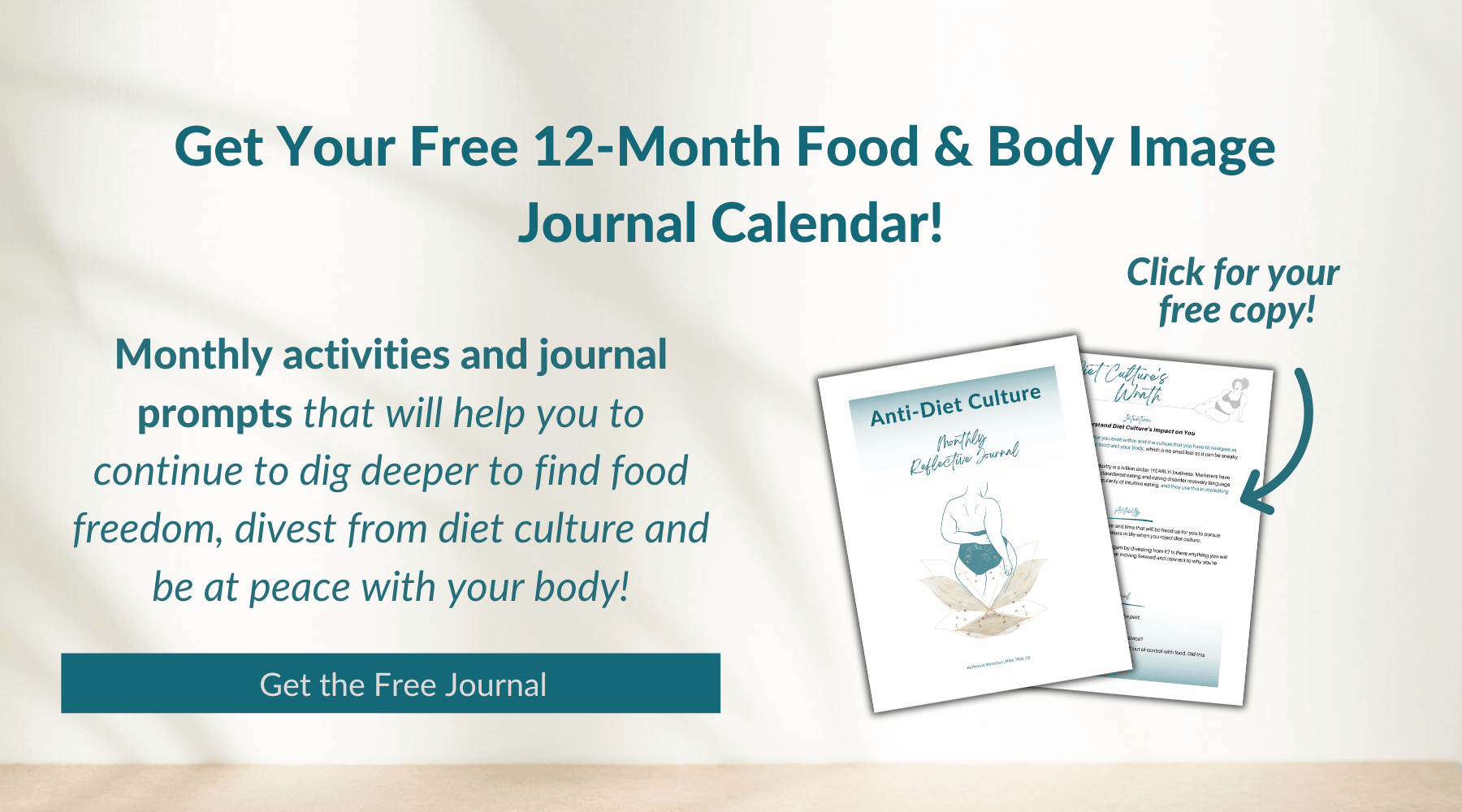
Download my free 12-Month Food & Body Image Journal Calendar. Each month includes journal prompts and reflections designed to help you reconnect with your body, challenge diet culture, and build a more peaceful relationship with food.
Still Feeling Confused About Hunger After Dinner?
If you're tired of second-guessing your hunger, feeling guilty for eating after dinner, or wondering whether you can trust your body, you don't have to figure it out alone.
I'm Katherine Metzelaar, a Seattle-based weight-inclusive dietitian specializing in eating disorders, disordered eating, and body image. Through virtual nutrition therapy, I help people better understand their hunger, rebuild trust with their bodies, and create a relationship with food that feels calmer, more flexible, and less confusing.
Healing your relationship with food is possible. You don't have to keep questioning your hunger or wondering if you're "doing it wrong." If you're ready for support, I'd love to help. If you're ready for support, I'd love to help. Learn more about my nutrition therapy services or schedule a discovery call.