
Why You Feel Guilty for Not Finishing Your Food (and How to Stop)
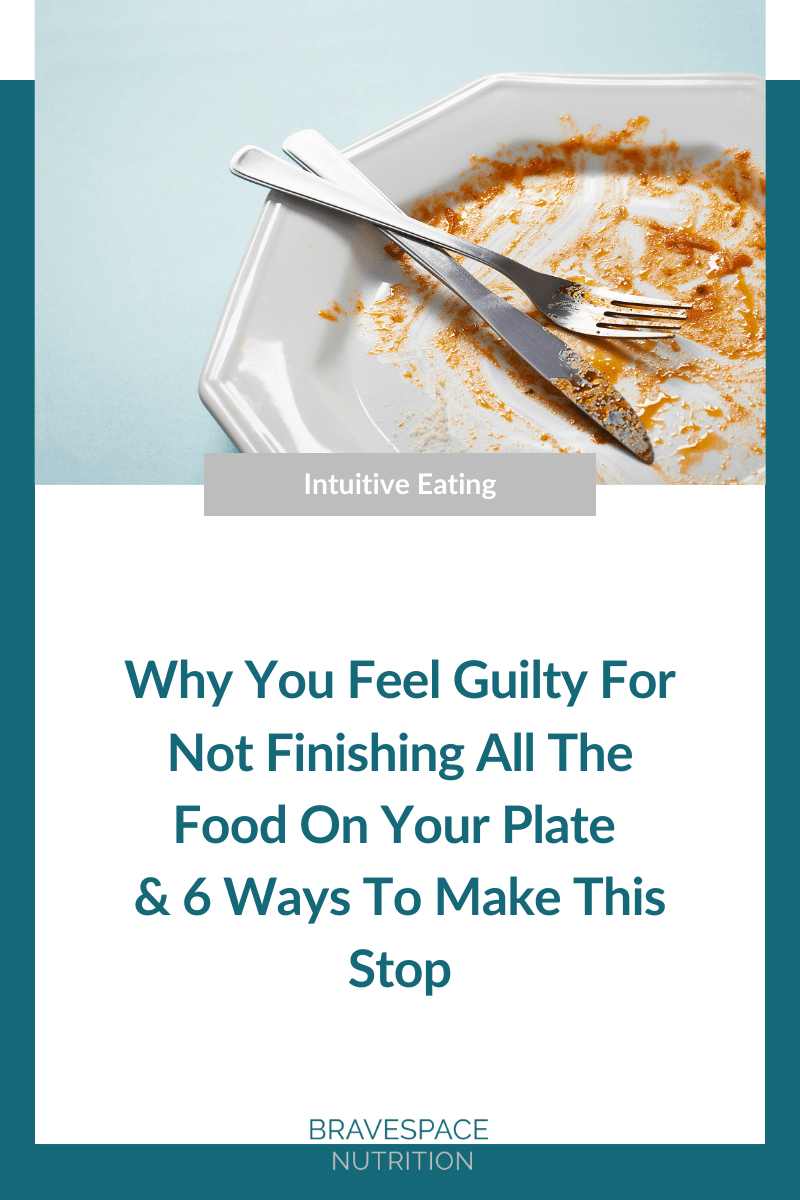
Do you find yourself wondering, "Why can't I finish my food?" or "Why do I never finish everything on my plate?" If you often stop eating before your plate is empty and then feel guilty about it, you're not alone.
There are many reasons you might not finish a meal. Your appetite naturally changes from day to day. Portions are often larger than what your body actually needs. Stress, illness, medications, and years of dieting can also affect your hunger and fullness cues. Often, the problem isn't that you don't finish your food. It's that leaving food on your plate feels uncomfortable or even wrong.
There is nothing wrong with finishing your plate, and it's a completely normal part of eating when that's what your body wants. But it can become difficult when you feel like you don't have a choice and continue eating even after you've had enough because throwing food away feels wasteful or leaving food behind brings up guilt. Diet culture, food insecurity, and your childhood experiences with food can all contribute to this feeling. The good news is that this pattern can be unlearned.
Why can't I finish my food?
If you've found yourself wondering, "Why can't I finish my food?" or "Why do I never finish everything on my plate?" you may have worried that something is wrong with you. In reality, there are many reasons someone might not finish a meal, and most of them are completely normal.
Your appetite isn't meant to be exactly the same every day. How hungry you feel can change depending on stress, illness, medications, hormones, your activity level, sleep, and even how much you ate earlier in the day. Portion sizes also aren't standardized to your body's needs, so it's normal for there to be times when you've had enough food before your plate is empty.
For some people, though, the most difficult part isn't not finishing the meal. It's what happens next. You may immediately feel guilty, worry that you're wasting food, or hear an internal voice telling you that you should keep eating. If that sounds familiar, it's likely that your struggle isn't simply about finishing your food. It's about the beliefs, experiences, and messages you've learned over time about what it means to leave food on your plate.
Understanding where those beliefs come from is an important first step toward having more choice around whether or not you finish your meal.
What’s the origin of the “Clean Plate Club”?
The Clean Plate campaign began in 1917 during WWI in the US as a government campaign to assure that the limited amount of food that was available didn’t go to waste and food importation was avoided whenever possible. Through public campaigns, people were told to finish everything by “not leaving a scrap of food on the plate” and to not eat between meals. Adhering to the clean plate club was encouraged as an act of patriotism. In this way, American Nationalism was used to encourage families to ration food. The goal behind the original campaign was to get people to eat less food overall and to be sure that when they did have food, it was all eaten.
After war rationing was no longer needed, the campaign ended. But, it was subsequently started back up in 1947. The “Clean Plate” campaign came back as the “Clean Plates Club” and was promoted in elementary schools across the country. President Truman at the time encouraged Americans to “consume less poultry to conserve food for starving Europeans.” Even though the Clean Plate Club began long ago, its effects still linger here in the US. Not having access to food, such as during times of war, is traumatic and this food trauma can be passed down from generation to generation.
In addition to this history, there are other reasons that you may be stuck feeling like you need to clean your plate. You may have developed a “clean your plate mentality” and feel guilty if you don’t finish what’s on your plate if you grew up in a household:
With strict rules and strict parenting around finishing the food on your plate
Where guilt was used to get you to finish your food
Where you had to finish your plate before being able to leave the table to go do things or go places
Where food was used a reward system (i.e you finish your plate or veggies and you get dessert)
In childhood, when parents set expectations for their children to finish what’s on their plate, use punishment, and/or deny fun foods if kids don’t finish their food, it creates a pattern of children learning how to override any cues for fullness in order to meet parents expectations and avoid punishment.
While childhood experiences often lay the foundation for food guilt, they aren't the only reason you may feel compelled to finish everything on your plate. Other life experiences can strengthen this pattern and make it even harder to trust your body's fullness cues. Here are some of those reasons:
A history of dieting
From a physiological standpoint, your body cannot tell the difference between restriction and starvation. If you’ve jumped from diet to diet, you’ve been through many iterations of restricting your food, and cutting out different foods and food groups. This means that you’ve restricted how much food you eat, the types of food you eat, when you eat, where you eat, and much more. When you’re dieting, your body doesn’t know the next time it will have access to food, so it urges you to finish the entire plate even if you are no longer physically hungry. And, even after you stop dieting, this feeling of needing to finish all your food lingers.
Not having consistent access to food
If you’ve experienced food insecurity or inconsistent access to food, your body will do everything it can to assure that you eat as much as possible when you finally do have access to food. Food insecurity is threatening to the body, and the urge to clean your plate when you don’t consistently have food to eat or don’t have enough food to eat is quite literally your body’s survival instinct. Your body is trying to protect you from the threat of starvation, causing you to eat past fullness in those moments. In this way, not all food restriction is voluntary. You may be experiencing food insecurity if you often find yourself:
Rationing out food, even though you’re still hungry
Wondering where your next meal will come from
Eating less so someone else in the household will be able to eat
Going the last few days or weeks of the month with having less food because of finances
Choosing between paying bills/getting gas or getting groceries
Going long periods of time without eating
Skipping meals and snacks, and other forms of not eating consistently can lead to you cleaning your plate even when you don’t want to. Remember that you cannot trick your body and if you haven’t eaten enough food to support your body’s energy needs in a day, weeks, or months, it will make sure you finish your plate when possible. In this way, finishing all the food on your plate is a normal, natural response to having inconsistent access to food.
Continuing to eat even when your body is telling you it doesn't want more food or even when you feel satisfied isn’t because you lack control or discipline. If you experienced food rules at home growing up, this behavior of cleaning your plate carries over into adulthood even when your parents are no longer around enforcing rules. Add to this any experiences of food insecurity, dieting, or a combination of both, and you may find yourself stuck in cycles of cleaning your plate and feeling like it’s impossible to change.

How can you break the habit of feeling like you need to finish everything on your plate?
Feeling the need to finish everything on your plate is much more complex than just “breaking a habit”. Good news is that there are many things that you can start doing today to help support you in understanding more of what’s going on when you eat and to have more choice around whether or not you want to finish your plate.
Here are specific steps you can take to get out of the cycle of feeling guilty or bad for not finishing what’s on your plate:
1.Stop dieting and restricting your food intake
If you keep your body in a cycle of food restriction, you’re going to continue feeling like you can’t stop eating and feel out of control with food. Give yourself permission to eat consistently without constraints on the time you eat or the types of foods you eat. Ending the diet-cycle will allow you to reconnect with your intuition and repair your relationship with food.
2. Honor your hunger
If you continuously deny your body’s cues for hunger, you will perpetuate this survival instinct to eat all the food on your plate even when you don’t want to. Not only does this mean allowing yourself to eat consistently throughout the day, but it also means letting yourself eat the foods that you want and crave. Food is more than just a means to survive. Food is connection, culture, community, and so much more.
3. Challenge what you’ve been taught about food

Get curious about your childhood experiences with food. In order for you to understand what messages you need to challenge, you’ll need to learn more and understand what food and mealtime was like for you growing up. You can do this by asking yourself these questions:
Did your family prioritize mealtime together and eat together or was everyone left to fend for themselves?
If you did eat together, what was the table experience like? Was it light-hearted filled with laughter and conversation, or did you find yourself tense or anxious at the table?
Were there arguments at the table?
Were you forced to finish your food through threats of starving children in other countries? Were you denied dessert if you didn’t finish your veggies or all the food on your plate?
Did you have to stay at the table until you finished the food on your plate?
Your food environment in childhood shapes how you interact with food in your adult life. Everyone has a different experience with food growing up and because of this, the first step to challenge your beliefs around food is to understand where they come from.
4. Get creative with your leftovers
Giving yourself permission to not finish your plate may lead to you having food leftover. This experience can elicit feelings of guilt for food “going to waste” and you feeling “wasteful”. After all, food is expensive! Finding ways to be creative with leftovers can be a way to mitigate any felt sense of guilt around food waste. Here are some creative ways you can spice up your leftovers and change the cooking game!
5. Practice self-compassion
Practicing self-compassion, the process of treating yourself in the same way that you would a loved one, is essential in healing your relationship with food. It’s okay and encouraged to be the caregiver that you didn’t have in your childhood. When feelings of guilt or fear arise when you don’t finish the food on your plate, feel afraid that something bad will happen if you don’t finish your plate, or you feel like you “should” finish your plate because other people don’t have food, try telling yourself things you wished you would’ve been told as a child, such as:
“It’s okay if you don’t finish this.”
“I’m glad you’re respecting your fullness.”
“You’re not a bad person if you don’t finish what’s on your plate. ”
“This will be waiting for you tomorrow, it’s ok to not finish it now. Do you want something sweet now?”
“It’s difficult when we eat to the point of uncomfortable fullness. Can I get you a blanket or cup of tea? Would you like to lay down? How about a hug?
Self-compassion allows you to recognize the hardships you have been through and validate your experiences both in the past and in the present. Changing the way you speak to yourself can make a big difference when you’re trying to decrease guilt for not finishing your food.
6. Get curious about the voice telling you to finish your plate
When you have guilty thoughts about not finishing your plate, or you feel the urge to clean your plate, pause and reflect on the internal voice that you may be hearing. Try asking yourself these questions:
How am I feeling right now?
Is this feeling a familiar one or is it new?
Is this a voice I recognize or does it remind me of anyone? If so, who?
Oftentimes, this voice that’s contributing to you feeling bad for not finishing what’s on your plate sounds a lot like someone you may have known in your life. This is not always the case though. There are times in which the guilt voice can be a conglomeration of all the messages you’ve received in your life from many people and industries about food and eating. Reflecting on this internal voice or messaging, and the memories that arise when you hear it, can give you insight into your current relationship with food.
Healing your relationship with food is a nonlinear journey and can take time. It’s not your fault if you feel the need to clean your plate and likely there are many things throughout your life that have contributed to the experience that you’re having. By trying some of these strategies, you will start to notice some shifts that will allow you to have more choice around whether or not you want to finish all the food on your plate or not. Remember that judgement has no place in healing your relationship to food and it can take time to understand your food experience.
You’ll also love…
Ready To heal Your Relationship With Food?
If guilt about leaving food on your plate has made eating feel stressful, confusing, or filled with self-doubt, know that it doesn't have to stay this way. At Bravespace Nutrition, I help people heal their relationship with food, reconnect with their hunger and fullness cues, and move away from rigid food rules so eating can feel more peaceful again. Whether you're recovering from chronic dieting, disordered eating, an eating disorder, or simply want more freedom around food, support is available. Learn more about my approach to nutrition therapy and how we can work together.